
Assistant clinical Professor | Ballmer Institute for Children's Behavioral Health
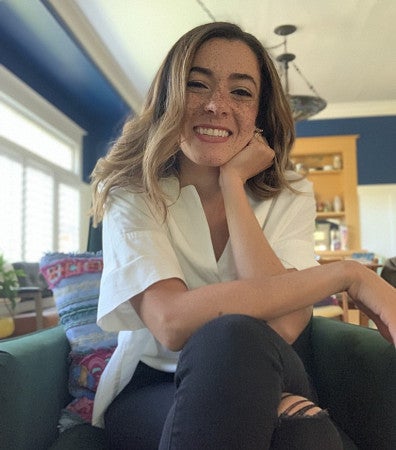
Katia Duncan is an Assistant Clinical Professor at the Ballmer Institute with over a decade of experience spanning acute care, crisis intervention, private practice, and school-based social work. A Licensed Clinical Social Worker in both Colorado and Oregon, she specializes in working with adolescents and young adults through her own practice, Untold Story, LLC, and brings that same commitment to her students in the classroom.
Q. Favorite book that inspires you:
I love everything by bell hooks (my students can attest to this). She wrote that love is an action, never simply a feeling. I think about that a lot. Love not as something you have, but something you keep choosing to do. That has really shaped how I think about relationships, about this work, about what it means to show up for someone over time.
And then Assata Shakur's Affirmations is something I also keep coming back to, especially the ending: the image of a lost ship, steered by tired and seasick sailors, still finding its way home to port. That one lives in me. Part of what I love is that there are multiple sailors. They aren't doing this work alone; they are tired together. Despite what people say, you can never totally fill your cup. There is always something that demands your energy, and if you try to steer a ship home by yourself, you will never make it.
This feels connected to a therapeutic relationship, too: someone who feels like they are navigating alone, in an act of hope, looking for a connection with another human that can help them get where they need to go. To be someone's step into hope is a true honor, even if, I too, am a tired sailor.
Q. You've worked in schools, private practice, crisis intervention, and higher ed—that's an unusually wide range. What drew you to keep moving across those different settings?
I didn't have language for it as a kid, but I was surrounded by people who believed proximity to struggle was not something to avoid. You show up. You figure out what's needed. You use what you have.
bell hooks wrote about the classroom as a place of transformation not just for students, but for everyone in the room. That's what schools gave me. I learned to mean what I said, to exist as a whole human in the room rather than be confined to a role, to hold space for breakups, for identity starting to crack open, for a young person beginning to imagine a future bigger than what they'd been handed. I showed up every day not knowing what was coming through the door, and I learned alongside my students about resilience, about what it actually means to survive something, about how much is possible when one person refuses to give up on you. Some of those students have passed away due to community violence. Some are college graduates. Some are just taking every day as a chance to build something better than what they started with. I carry all of them.
I loved my time in schools. Crisis work, private practice, and the other jobs I held let me go deeper into what I was already doing in there. And I kept moving because I kept finding things I didn't know yet, and that felt more alive than staying somewhere comfortable.
Q. What do you hope students take away from working with you—not just knowledge, but how they think about the work?
I hope they leave with more questions than they came in with but better ones. I want them to be less interested in having the right answer and more interested in understanding the conditions that shaped the question. And honestly, I hope they feel like it's okay to not have it all together. The work requires humility, and humility requires admitting you're still learning. I try to model that, not just say it.
Q. What's something you wish someone had told you early in your career?
That sustainability is a practice, not a reward you earn after you've worked hard enough. I spent a long time thinking I'd rest when things slowed down, and things don't slow down. The people who stay in this field (really stay, not just physically but emotionally) are the ones who figured out how to build a life that's bigger than their work. I had to learn that the hard way, and in many ways I am still learning. I wish someone had said it out loud sooner for me to realize that sustainability requires intention.
Q. What does "untold story" mean to you? Why did you name your practice that?
The name comes from Maya Angelou: "There is no greater agony than bearing an untold story inside you."
Growing up biracial and bicultural, in a home that didn't quite have the language for the nuances of identity, I learned early that the pretty, legible version of me was the one people felt comfortable with. The mess of it, the parts that didn't fit neatly, stayed quieter. Learning to say those things out loud, to make the implicit explicit, changed something in me. I realized that the mess is actually part of the story, not a detour from it.
So much of what people carry into a therapy room is something they haven't been able to say out loud yet. Sometimes because no one asked. Sometimes because it didn't feel safe. Sometimes because the language wasn't there yet. The work, as I understand it, is creating the conditions where those stories can actually surface. Every person who walks in has something in them that hasn't been fully told, and that's the starting point.